Artificial Intelligence: Undermining Education and Humanity
As generative AI becomes normalized in classrooms and creative spaces, concerns grow over its impact on human innovation, ethics, and the very meaning of originality in education.
By Sofia Ferry
Beyond an academic setting, AI has always been concerning. Its interface runs on human creation. Such activities that we humans have always been completely capable of doing: visuals, comprehension and innovation. While we can say that it is only currently trying to imitate humans, who’s to say it’s not trying to become human? I believe that the start of the end of true human innovation and liberties begins with the apparent normalization of generative AI use.
Ever since ChatGPT became a household name upon its release in 2022, generative AI tools and AI-generated material have been ubiquitous. City College Campuses are not immune to this wave of influence, despite what it represents under the lens of academia.
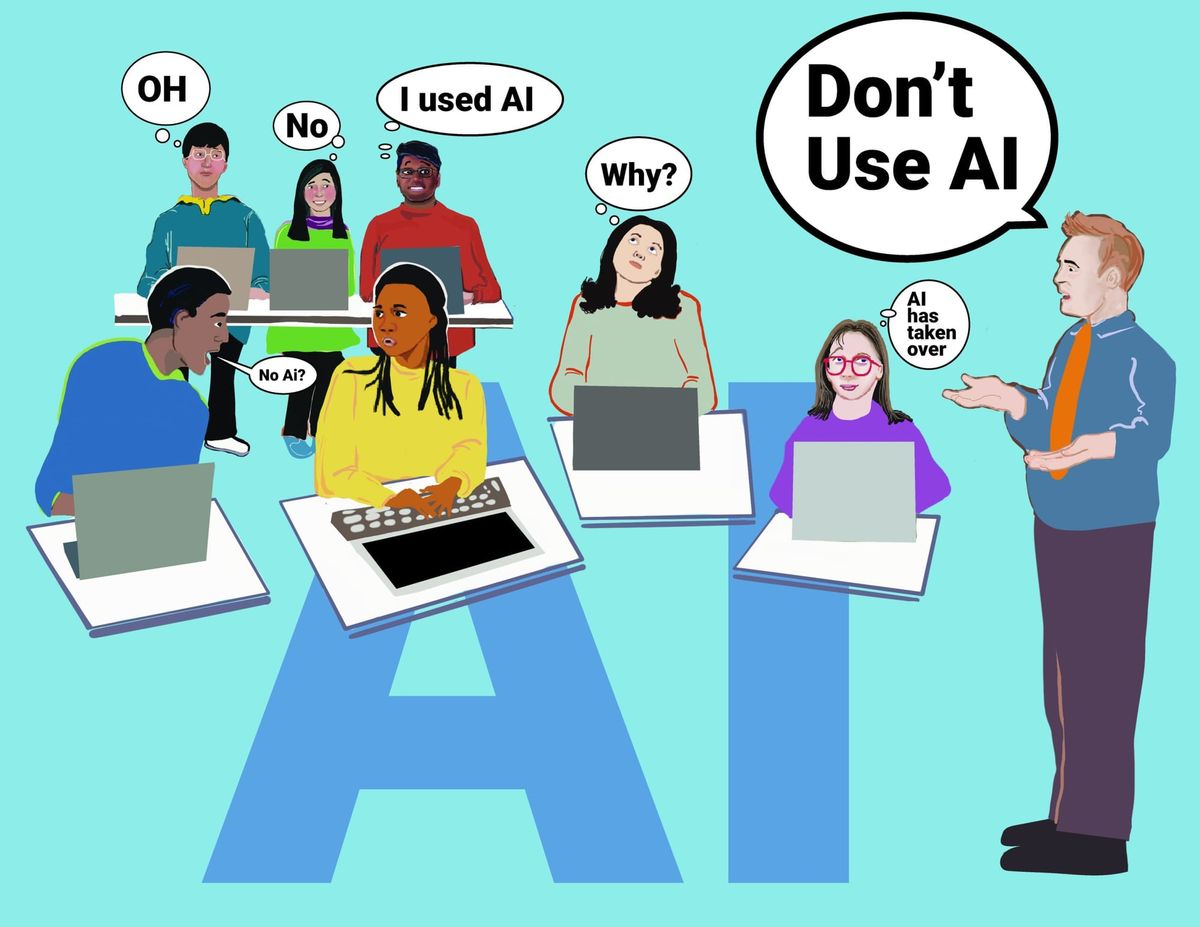
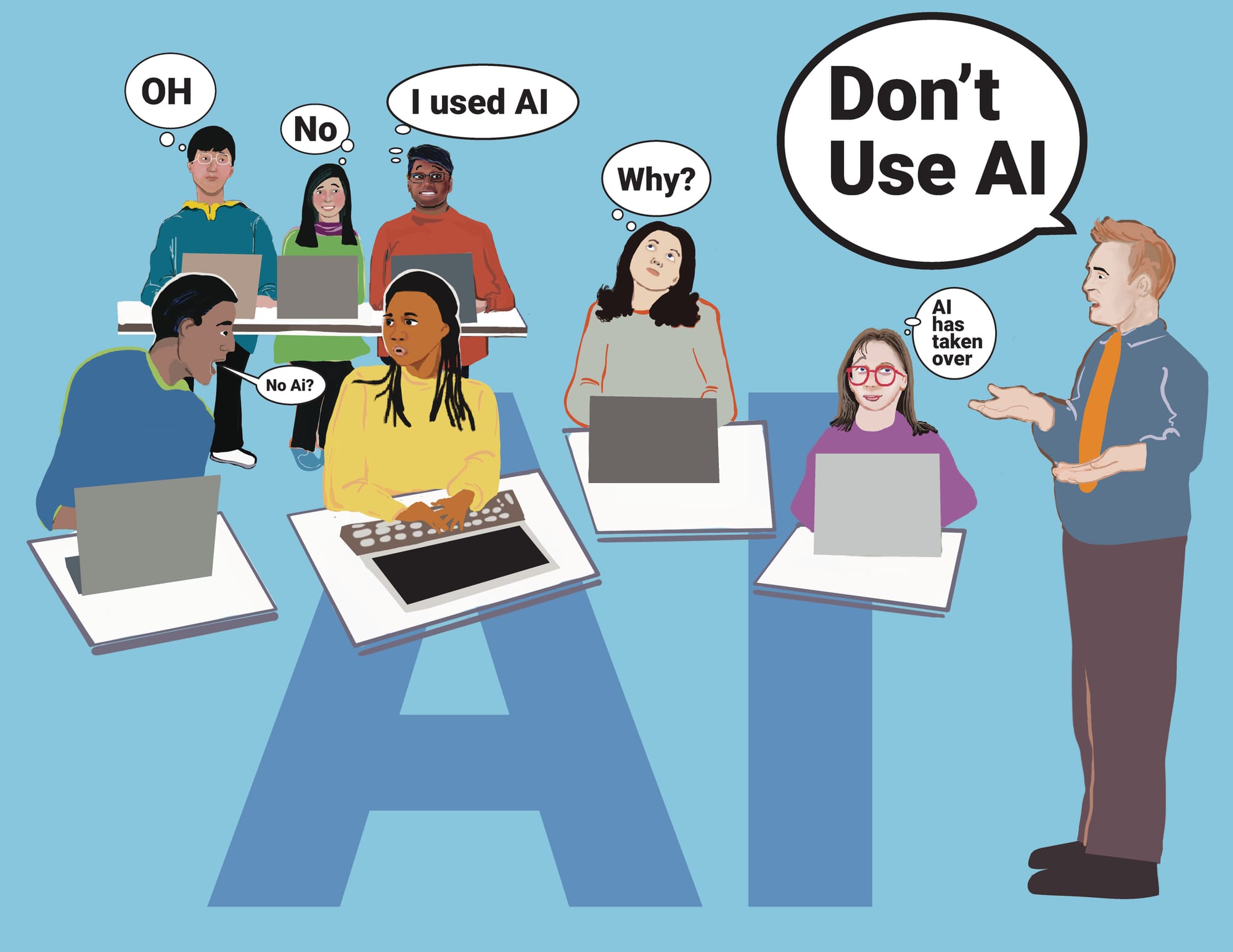
Student-made flyers, campus promotional material that was swept under the rug despite the evidence against it, and even, in my own experience, professors are using AI for their Canvas modules. The existence of AI in academic settings is only one iteration of the current list of repercussions this technological advancement has unleashed. With the current sentiments of balancing safety and innovation on the policies in place, both general and academic, AI has already taken over.
Section 8 of City College’s Code of Student Conduct, which deals with academic or intellectual dishonesty, defines that there is an ethical and unethical use of AI tools on school tasks. The Library Skills Workshop on Academic Integrity has a section titled “Ethics and Artificial Intelligence in Academics,” which provides this definition: ethical use would be following an instructor’s policy, but its usage only extends to its intended purpose and “should never replace your own original work in any way,” and unethical use would be going against instructor policy, or claiming AI-generated material as your own work.
They also attach an article by The Conversation, “Should AI Be Permitted in College Classrooms? 4 Scholars Weigh In.” The feedback of the featured professors varies in opinion, such as seeing AI’s potential as a helpful tool, AI promoting convenience and reliance mentalities and the importance of considering the challenges it will bring to students’ envisioned careers.
The existence of AI tools implies a desire to replace human innovation, instead of it simply being a tool. It is absolutely promoting convenience and reliance mentalities. Seeing AI-generated material in academic spaces, where the intention is to develop not only critical thinking but human skills, is an ostracizing experience. I often find myself upset at the sight of yellow-tinged, too-smooth textures of an illustration when I walk around campus.
All of this is just the tip of the iceberg of AI, with untold consequences. On one hand are the opportunities that AI takes away from human potential: creativity, livelihoods, wellbeing, and physical repercussions. On the other hand is how artificial intelligence is currently being weaponized, such as Immigration and Customs Enforcement (ICE) developing its surveillance arsenal through contracts with AI software companies.
Physics Nobel laureate Geoffrey Hinton, dubbed ‘The Godfather of AI,’ gave a speech during the Nobel Prize Banquet. He focuses on the severe utilization of AI:
“Unfortunately, the rapid progress in AI comes with many short-term risks. It has already created divisive echo-chambers by offering people content that makes them indignant. It is already being used by authoritarian governments for massive surveillance and by cyber criminals for phishing attacks. In the near future, AI may be used to create terrible new viruses and horrendous lethal weapons that decide by themselves who to kill or maim. All of these short-term risks require urgent and forceful attention from governments and international organizations.”
With a perspective like mine, rooted in intersectionalities such as being Gen Z, holding onto youthful hopes, and hell, even being an aspiring creative, the mere sight of AI-generated material feels like a stab to my human soul.
Here’s to hoping that the current regulatory policies on Artificial Intelligence will prove to be productive for human values and principles.