SoMa Houses the City’s Largest Newsroom, Yet Its Residents Lack a Newspaper
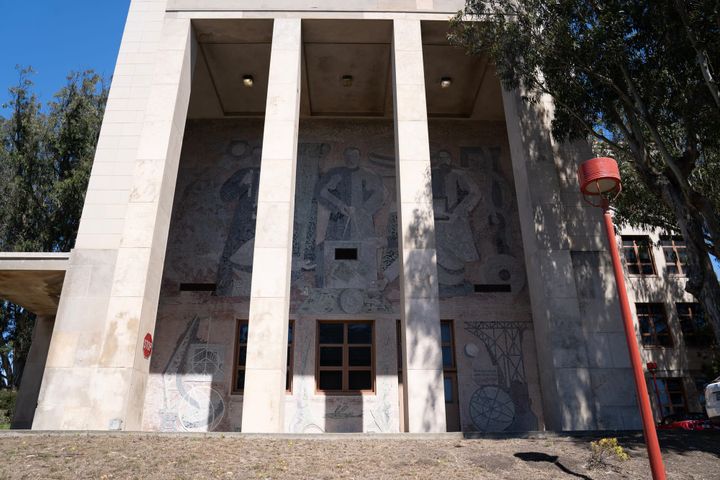
On Fourth and Mission sits the college’s unassuming Downtown Center, only a block from the San Francisco Chronicle’s glowing headquarters. Even with a beacon of learning and the city’s flagship newspaper at its core, South of Market lacks a press of its own.


By Marrion Cruz
On Fourth and Mission sits the college’s unassuming Downtown Center, only a block from the San Francisco Chronicle’s glowing headquarters. Even with a beacon of learning and the city’s flagship newspaper at its core, South of Market lacks a press of its own.
Community nonprofits like SOMCAN, West Bay and United Playaz help fill the gap, producing newsletters and fighting to preserve SoMa’s heritage against development pressure. But residents say these efforts don’t substitute for comprehensive coverage.
“SoMa’s diversity hasn’t protected it from becoming invisible in San Francisco’s media ecosystem,” said Alexa Drapiza, a community organizer and decades-long resident near St. Patrick’s Church on Mission Street.
Coverage of the neighborhood comes in fragments. Mission Local reports on redevelopment battles, the Bay View covers housing and equity citywide and the Potrero Hill View occasionally includes SoMa in its monthly print run.
“You have to live in the neighborhood to know what’s going on,” said Chen, a Howard Street resident who requested an alias. He described daily walks down Sixth Street to his job north of Market, where he often steps over unhoused residents. “It feels dehumanizing to have to do that.”
South of Market, Out of Print
Historically, SoMa relied on a strong tradition of hyperlocal journalism. Filipino community papers like the FilipinoSTAR and Philippine Daily Inquirer once circulated at the Mint Mall on Mission Street and the Bayanihan Community Center on Sixth. STARCO, a Chinese-Filipino corner store on Howard Street, stacked newspapers until it closed under zoning restrictions.
Other institutions stepped in when print papers faded. Bindlestiff Studio, a performing arts venue founded in 1989, became a cultural anchor. Balitang America, a 30-minute Filipino-language news program broadcast from 2002 to 2021, offered another outlet. But its shutdown left a void in the neighborhood’s cultural storytelling.
Newsletters have helped stitch together SoMa’s communities. From 1944 to 1976, Cable Tow: Gran Oriente Filipino, published in both English and Tagalog out of South Park, chronicled the Filipino diaspora in San Francisco. Earlier, Irish immigrants published South of Market Journals, written by the South of Market Boys — one of whom, Anthony Rossi, later became mayor.
Community Under Construction
At the Mint Mall, Filipino families once lived in single-room occupancies above storefronts, with news circulating downstairs and by word of mouth in hallways. The Bayanihan House, an SRO associated with Mint Mall, became another hub of community life. This resulted in its 1010 Mission lobby becoming the Bayanihan Community Center. Bayanihan is Tagalog for community; it translates as being of one community.
Meanwhile, SoMa’s demographics and identity continue to shift. Since the dot-com boom of the 1990s, the neighborhood has drawn tech companies and AI startups. Even its name is debated — “South of Market” versus “SoMa,” and more recently “Gotham,” the pejorative label spotted on a tech billboard last week.
Chen still gets email newsletters from SOMA Pilipinas highlighting Yerba Buena arts events, which sometimes include announcements.
“I haven’t seen one about the recreation center. Or why it’s taking so long.” He said only a neighborhood paper can sufficiently track hyper-local projects.